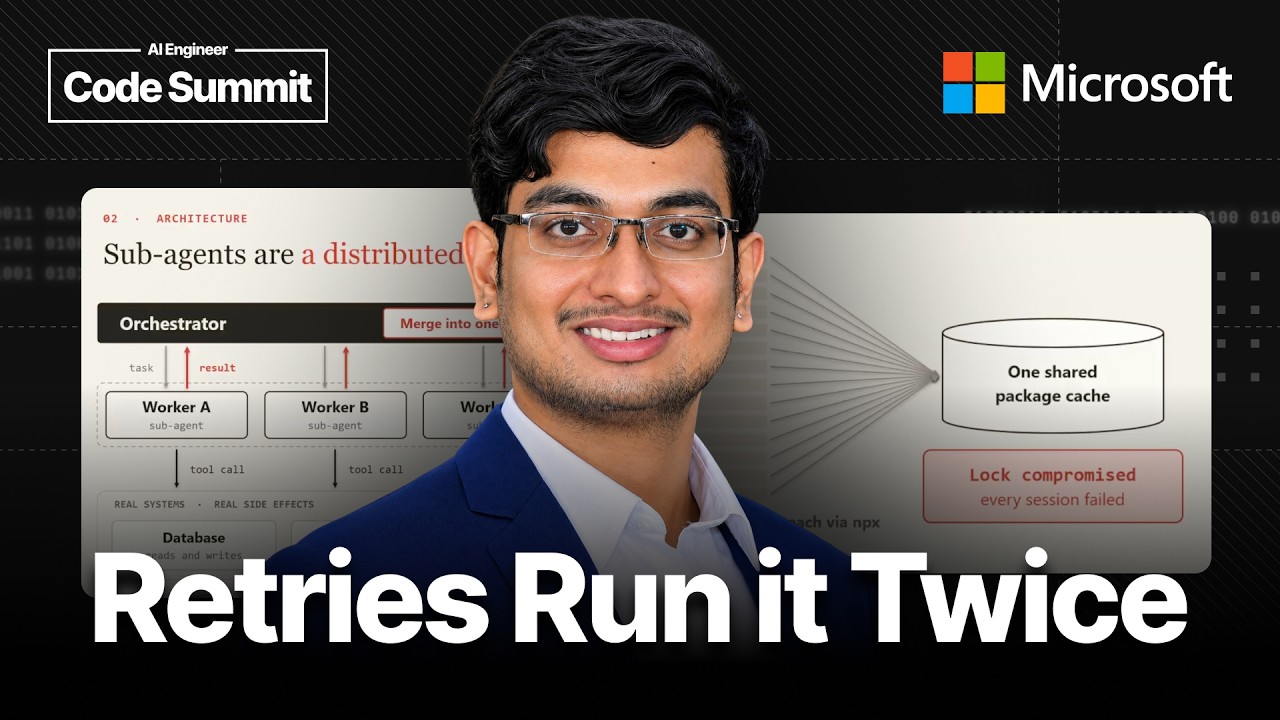
Sandipan Bhaumik advises passing agents immutable, versioned state instead of a shared record
Sandipan Bhaumik tells how a stale cache gave one agent in a five-agent credit system the wrong score. Separately, he recommends distributed-systems practice for agent state: sealed, versioned snapshots checked against a contract. He reports no results from that design.
 Watch from 2:11
Recording by AI Engineer.
The idea
The speaker’s argument, in our words.Bhaumik's argument is that adding agents turns an AI project into a distributed system, with the usual race conditions and stale reads. His war story is a credit-decisioning workflow for a financial services client: one agent wrote a new score to Postgres, but a cache in front of the database was not invalidated, and the risk agent read the old score half a second later. In his account, nothing was wrong with the model or the prompts. He does not say how the cache was fixed.
His general prescription for state is to stop sharing a mutable record; he does not say it was applied to the credit system, and he reports no results from it. An orchestrator stores each agent's output as a new, immutable version in an append-only log and passes that version to the next agent, which checks it against a declared schema (and can reject it, for example when a confidence score is too low) before producing the next version. Replaying the versions shows what each agent received and returned, so a bad result can be traced back step by step. He pairs this with circuit breakers around agent calls and compensating actions to undo completed steps when a later one fails.
What they found
From the talk. Figures are self-reported unless stated.Four agents were added to a credit-score agent that had run two weeks without issues; within three days about 20% of decisions had incorrect risk ratings. The cause was a cache in front of Postgres: the credit agent's write (750) succeeded, the cache was not invalidated, and the risk agent read the old score (680) 500 ms later.
Self-reported war story for an unnamed client; number of decisions not given. He frames it as an architecture problem, not a model or prompt problem.
Case study
2:11Store each agent's output as an immutable, versioned snapshot in an append-only log held by the orchestrator, and pass versions between agents instead of updating a shared record.
His general prescription. He notes databases do offer locks and isolation levels, but says many teams keep the defaults and ship race conditions. He illustrates the prescription with two agents overwriting the same record, not with the cache incident, and does not report results from applying it to the credit system.
Technical recommendation
12:40Give every handoff a data contract: the receiving agent declares the fields it needs and rejects input that fails them, such as research findings with confidence below 0.7.
Illustrative threshold from his example code, not a recommended value.
Technical recommendation
15:42
Why it matters
Our reading. Not said in the talk.Three talks in the library treat the same lost-update problem with different designs. Vinoth Govindarajan keeps shared mutable state but allows one ordered commit path per state boundary (a queue, lock or transaction). Girish Konda attaches a source version to every fact a sub-agent hands on, so decisions can refuse stale ones. Bhaumik proposes removing the shared record altogether. In our reading, the choice depends on whether agents need each other's latest writes or only their own inputs.
What one could try
- Check whether any two agents read and write the same record, directly or through a cache; if so, consider passing explicit state versions through the orchestrator instead.
- Validate each handoff against a schema at the receiving agent and fail early, before bad data reaches later steps.
- Keep every state version so you can step back through a failed run to the first bad output.
Limitations
- The credit-system incident is a single, self-reported story with no sample size; the immediate bug was cache invalidation, and the immutable-state design is his general advice, not a measured fix for that system.
- His claim that coordination complexity grows exponentially does not match his own count (10 pairwise links for five agents grows quadratically).
- Parts of the talk map the patterns onto Databricks products, where he works.
Original sources
AI Engineer Europe 2026 · Apr 8, 2026
From Chaos to Choreography: Multi-Agent Orchestration Patterns That Actually Work
Sandipan Bhaumik · Databricks · 26 min
This is our synthesis of the talk, checked against the transcript at the linked moments.