Girish Konda argues every sub-agent handoff should be treated as a network call
Drawing on failures in his open-source MCP Pacemaker bridge, such as timeouts that hid the real cause and parallel cold starts that broke a shared package cache, Konda proposes SAFE handoffs: sourced facts, at-most-once effects, fan-out budgets and explicit outcomes.
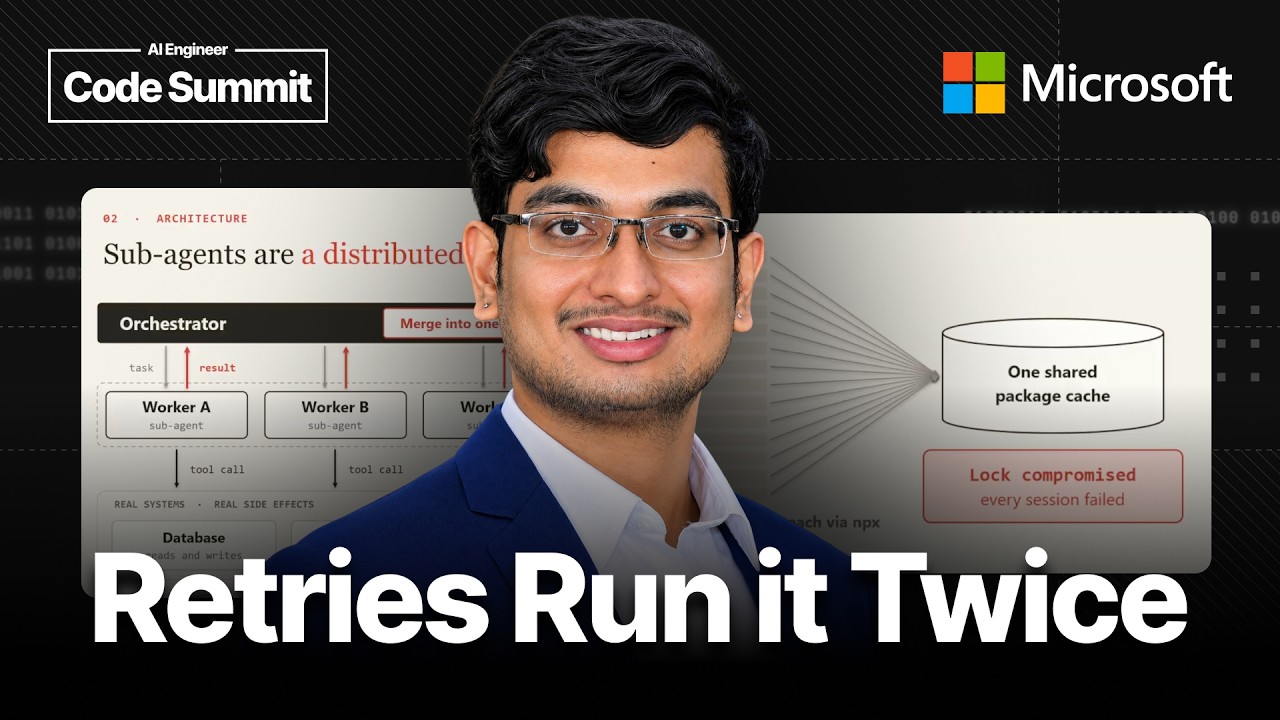 Watch from 5:12
Recording by AI Engineer.
The idea
The speaker’s argument, in our words.Konda, a principal software engineer at Microsoft who says the views in the talk are his own and not his employer's, builds MCP Pacemaker, an open-source bridge that keeps MCP servers running. The failures he describes from it are textbook distributed-systems failures. A server that downloaded itself on first run hit the call timeout and looked broken when it was only slow. A server that crashed mid-call had its exit code overwritten by the timeout that followed. Many sessions cold-starting through npx at once, sharing one package cache, all failed on npm lock errors, though no single request was wrong.
From this he argues that an orchestrator handing work to sub-agents that share state and call real tools is a distributed system with none of the usual guarantees, and proposes a model he calls SAFE handoffs, presented as his own and not universal. Sourced facts: anything passed between agents carries its source, version and timestamps, because agents that agree after reading the same shared context are one source counted several times. At-most-once effects: every write has an identity and a single-use approval, and its outcome is read back, never replayed. Fan-out budgets: each downstream gets a concurrency gate with a bounded wait, and a refusal counts as a failure. Explicit outcomes: every handoff ends in a named state that can say partial, stale or unknown, a timeout is recorded as unknown with its cause, and the orchestrator checks results in code.
What they found
From the talk. Figures are self-reported unless stated.In his MCP Pacemaker bridge, a server downloading itself on first run hit the 30-second call timeout and looked broken; giving initialization its own timeout fixed it. In the other direction, a timeout overrode the exit code of a crashed server, fixed by recording the timeout only when the server was alive.
Speaker's own open-source project. His conclusion: a timeout is a suspicion, to be recorded as unknown while keeping the real cause.
Case study
5:43Concurrent npx cold starts sharing one package cache all failed with npm lock errors; the bridge now gates package-manager cold starts two at a time with a wait bounded at 15 seconds, and caps sessions with a 10-second wait before refusing, a refusal that counts as a failure in health.
After 15 seconds a start proceeds without the gate, a documented choice of availability over cache safety.
Case study
17:14Make failure a value: a sub-agent returns a status, what it did and did not do, its evidence and side effects, keeping "could not check" distinct from "checked and found no". A2A task states and the MCP isError flag already have slots for this.
The speaker notes a sub-agent can still mark a task completed while its text says otherwise.
Technical recommendation
6:14Give every side effect an identity, bind approval to that exact action for one use, and read back by identity after the call: submitted is not confirmed.
Motivated by an illustration from his article about the bridge: a sub-agent creates a PR, the reply is lost, the orchestrator retries the whole task and the write happens again (13:05).
Technical recommendation
15:09
Why it matters
Our reading. Not said in the talk.Much multi-agent code passes strings between agents and lets the next model interpret them. Konda's bridge failures show the problems are the familiar ones from distributed systems, and his model turns each into a check an orchestrator can run in code.
What one could try
- Define a result schema for sub-agents with status, completed and skipped steps, evidence and side effects, and map timeouts to an unknown state that keeps the underlying error.
- Attach an identity to every write a tool makes and read it back before any retry.
- Store shared facts with their source and read time, and give agents that cross-check a claim independent sources.
Limitations
- A design proposal from one engineer's own open-source project and writing; no production measurements and no comparison against unstructured handoffs.
- Several examples (the alert triage, the 80% error rate, the freshness timeline, the 10-in-1,000 calculation, the duplicated PR) are made-up illustrations.
- By his own account SAFE does not make facts true, give exactly-once delivery or roll back partial work, assumes a single orchestrator, and is mostly overhead when a person reads a sub-agent's draft before anything happens.
Original sources
AI Engineer CODE Summit 2026 · Nov 11, 2026
Sub-Agents Are a Distributed System (And Nobody Gave You a Consistency Model)
Girish Konda · Microsoft · 23 min
This is our synthesis of the talk, checked against the transcript at the linked moments.