Vinoth Govindarajan wants every agent action to leave a receipt beyond the transcript
Vinoth Govindarajan uses public OpenClaw issues to argue that many agent failures are harness failures: replies that were never persisted, writes that erase each other, stale approvals. His fix is a receipt that records what the system allowed, ran and confirmed.
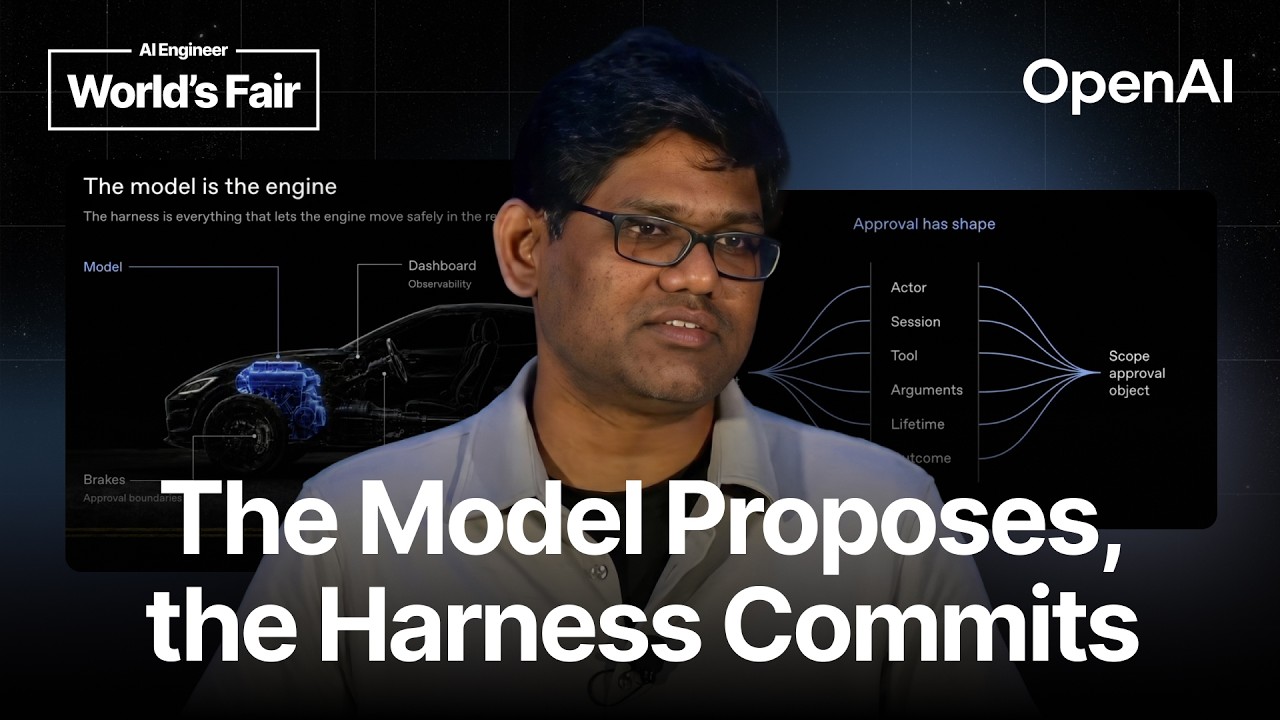 Watch from 2:39
Recording by AI Engineer.
The idea
The speaker’s argument, in our words.Govindarajan's rule is that the model proposes, the harness commits and a receipt proves what happened. A transcript only shows what the agent said, and a tool result only shows what one component reported. A receipt should record the trigger, the state the run inherited, the authority it used, the call it executed (with attempt number and idempotency key) and whether the user-visible edge, such as a rendered message or an updated ticket, confirmed the outcome.
He builds the case from five public OpenClaw issues: a reply delivered but never written to the session record, two writers whose whole-snapshot saves overwrite each other, a tool call with no result that leaves the session waiting, an expired approval that keeps retrying, and a message tool that reports success for a message the user never sees. None of them is fixed by a better model, he argues, because the model reasons fluently over whatever incomplete history the harness hands it.
What they found
From the talk. Figures are self-reported unless stated.A Telegram reply reached the user, but the turn was not written to the active context or transcript, so the next turn had no record of the exchange while logs looked healthy.
A public OpenClaw issue used as a case study. The speaker says he is not an OpenClaw maintainer; frequency and impact are not given.
Case study
6:07A message tool reported success for a web chat run, but the message never rendered; the agent could later say it had sent it while the user truthfully said they never saw it.
Public OpenClaw issue, the inverse of the first case: here the tool result is wrong about what the user saw. No frequency given.
Case study
13:00Two callers loaded the same state, each changed a different record and saved the whole snapshot, so the second save silently erased the first; a dismissed commitment could come back or a follow-up arrive twice.
Public OpenClaw issue (load-modify-save race). His remedy is one ordered commit path per mutable state boundary, not serialising the whole agent.
Case study
7:56
Why it matters
Our reading. Not said in the talk.Two other talks in the library reach this from different sides. Brian Kennedy (ZoomInfo) found an LLM judge believing an agent's report over its tool results, and moved to checking the tool results. Govindarajan's edge cases show that a tool result can be wrong too, so the strongest receipt is the effect the user can see. Girish Konda's SAFE handoffs for sub-agents draw the same line between submitted and confirmed. Most of this is ordinary distributed-systems practice that can be added to a harness without touching the model.
What one could try
- Pick one production agent path and check whether you can answer his five audit questions from stored records alone: what woke the agent, what state it inherited, which authority it used, what executed and what evidence survived.
- For each fact the agent relies on later, name the system of record that owns it and test that a new turn can replay it.
- Give every tool call and run a terminal outcome (success, failure, timeout, cancel, attempts exhausted) and store it.
Limitations
- The incidents are public issues from one open-source project, summarised by someone who does not maintain it; the talk does not link them or say how often they occur.
- No measurement shows that receipts reduce failures; this is a design argument.
- The speaker works at OpenAI but presents this as a personal system design talk, not OpenAI's practice.
Original sources
AI Engineer World's Fair 2026 · Jul 29, 2026
Your Agent Didn’t Fail. Your Harness Did.
Vinoth Govindarajan · OpenAI · 18 min
This is our synthesis of the talk, checked against the transcript at the linked moments.