Once agents could start tasks, Harvey's platform needed dedup and a fair launch queue
Harvey made every action on its internal agent platform callable from a CLI. Joey Wang describes the two floods that followed, an alert storm and one engineer's bulk launch, and the dedup and fair launch queue built in response.
 Watch from 5:13
Recording by AI Engineer.
The idea
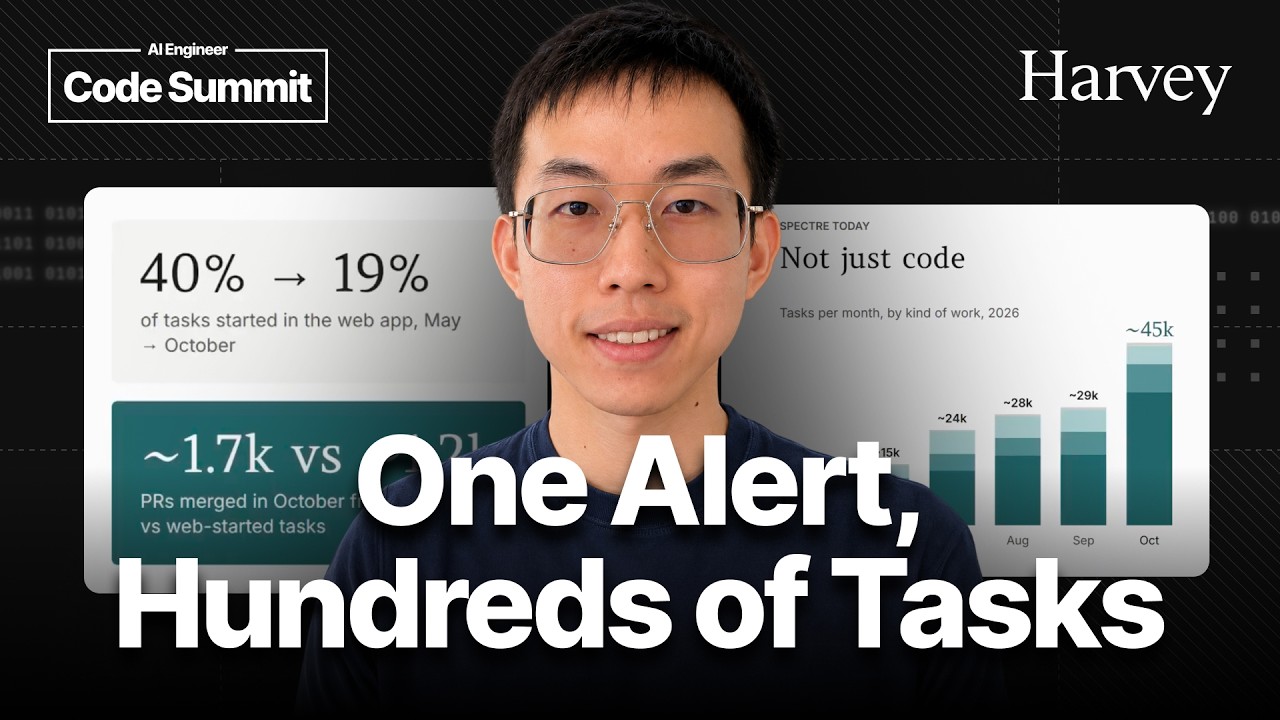
The speaker’s argument, in our words.Harvey adopted a rule for Spectre, its internal agent platform: if a person can click it, an agent can call it. Starting tasks, enabling the follow-up loop and arming auto-merge all became CLI commands that laptop agents, agents inside sandboxes and CI could call. By October the CLI was starting about 6,500 tasks a month.
The same openness removed the natural rate limit of a person clicking. In mid-August a release bug fired one alert per workspace, a workflow tagged the agent on every alert, and in about four hours some 900 tasks started, against roughly 50 on a normal day, all chasing the same bug until the cluster had no room. The fix was to make repeat alerts join the investigation already open. In October an engineer legitimately handed about 950 tasks to the platform in three hours, and everyone else queued behind one laptop. Wang calls that the platform's problem, not the user's. Four days later the team shipped a fair launch queue: starting a task gives a place in line, people at a keyboard go first, each person gets a fair share and can borrow more when the cluster is quiet. Scheduled automations got their own guardrails: they switch off after five consecutive failures and can carry a budget or an expiry date.
What they found
From the talk. Figures are self-reported unless stated.Every product action became callable from the CLI; by October the CLI was starting about 6,500 tasks a month, and some users started hundreds of tasks a month without opening the app.
Self-reported. The unit is transcribed as 'ts' and read as tasks from context.
Case study
5:45In mid-August an alert storm started about 900 tasks in about four hours, against roughly 50 on a normal day, all chasing the same bug until the cluster had no room; repeat alerts now join the open investigation.
Incident account.
Case study
7:49In October one engineer started about 950 tasks from the CLI in about three hours and filled the cluster; four days later a fair launch queue shipped with interactive priority, fair shares, borrowing and visible queue position.
Incident account. Wang calls it a platform problem, not a user problem.
Case study
8:20About 110 people had automations running last month; an automation that fails five times in a row switches itself off and can carry a budget or expiry date, because unattended agents can also start thousands of tasks.
Guardrails described as learned from experience.
Technical recommendation
10:56
Why it matters
Our reading. Not said in the talk.Internal platforms are usually sized for people, whose clicking speed limits demand. When agents, scripts and alert workflows become the main callers, overload and starvation become the failure modes. Harvey's two incidents had different causes (duplicate triggers and legitimate bulk use) and needed different fixes.
What one could try
- Add a dedup key to alert-triggered agent tasks so repeats attach to an existing task.
- Put a launch queue in front of your sandbox cluster with per-user fair shares and priority for interactive work.
- Give every scheduled automation a consecutive-failure cutoff and a spending cap.
Limitations
- Self-reported incidents and figures from one company.
- Wang says several fixes shipped together, so he cannot say which mattered most; the before and after finish-rate figures are garbled in the transcript and are left out.
Original sources
AI Engineer CODE Summit 2026 · Nov 11, 2026
The harness has to finish the job
Joey Wang · Harvey · 13 min
This is our synthesis of the talk, checked against the transcript at the linked moments.