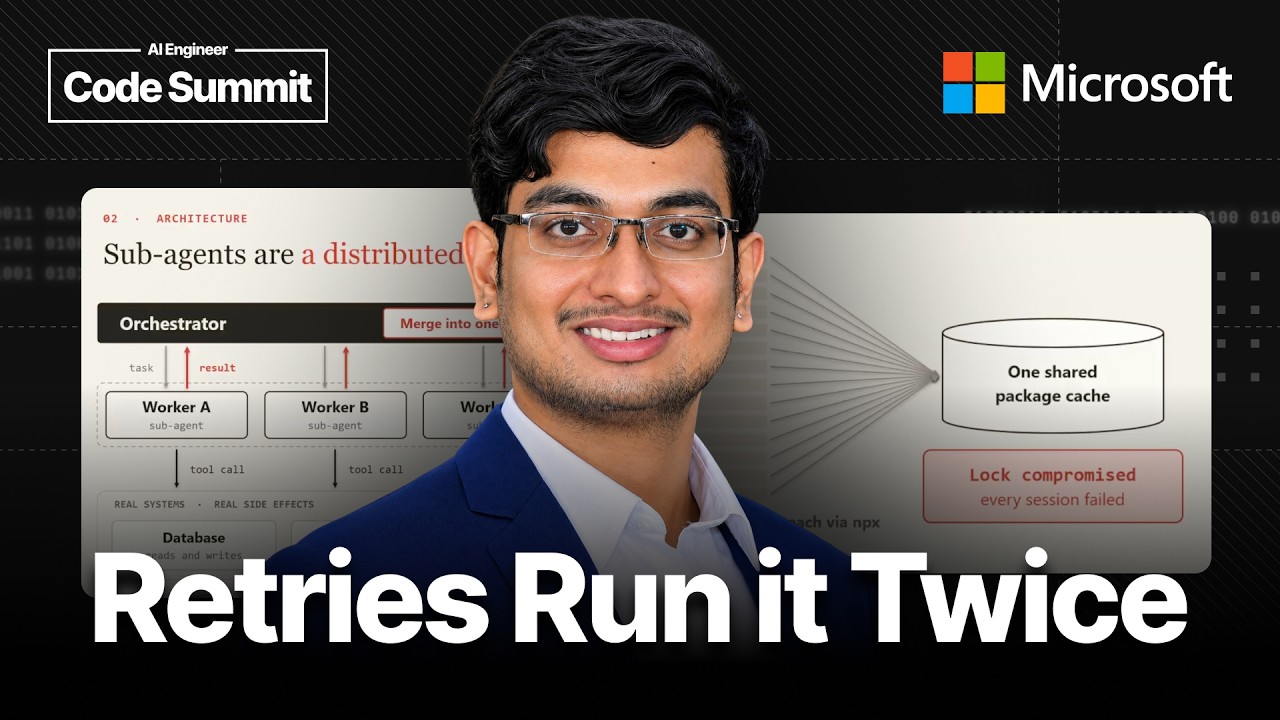
Databricks branches data, conversation and files so agents can try fixes on a copy
Ankit Mathur of Databricks describes branching tables, compute, conversation, memory and sandbox files so agents can test fixes on an isolated copy of the real system and report a tested result instead of a theory for a human to try.
 Watch from 5:07
Recording by AI Engineer.
The idea
The speaker’s argument, in our words.A code branch covers a small part of what an agent needs to experiment safely. When a data pipeline breaks, the useful test is to rerun or change the pipeline against real data, which nobody wants an agent doing in production because a partially broken pipeline may already have written data. Mathur's team branched the data platform itself (tables, compute and governance) so agents could investigate several hypotheses in parallel on isolated copies. Before that, he says, the model returned a text theory and a person had to go and try it.
The same applies to agent state. A branched agent inherits the conversation, but its new turns must not change the original. Agents also rely on the notes, plans and scripts they write to disk, and Mathur says branched agents started without those files were less effective, so the team built a branchable file system with a local cache synced to remote storage. Underneath is copy-on-write storage (Neon Postgres separates compute from storage), so branches share history and only isolate new writes. His argument is that the more of the real working state can be branched, the less a human needs to sit in the loop approving each step.
What they found
From the talk. Figures are self-reported unless stated.Databricks branched its data platform (tables, compute, governance) so agents could test hypotheses about a broken pipeline, such as rerunning changed upstream code, on a copy; Mathur says agents can then check about 10 ideas in parallel and report a tested conclusion, where before the model returned a text theory a person had to try.
Databricks sells the Neon-based branching it describes. '10 ideas' is the speaker's illustration of scale; no success rates, costs or latency were given.
Vendor claim
5:07When a new reply comes in on a branched agent, it should not change anything in the original agent's conversation; the branchable database makes this possible.
Conversation state is stored in the branchable Neon database.
Case study
7:42Branched agents started without the parent agent's files were less effective, which led the team to build a branchable file system with local and remote cache syncing.
Qualitative observation; no numbers on effectiveness or branching latency.
Case study
11:22Branching relies on separating compute from storage, so branches share history via copy-on-write and only new writes are isolated.
Built on the Neon Postgres database, which Databricks offers as a product.
Technical recommendation
10:20
Why it matters
Our reading. Not said in the talk.Mathur argues that humans inserting themselves as an approval layer is what holds agents back from looping on a problem. An isolated copy of the real state moves part of the safety boundary from approval to isolation, but only for the parts of the system that are actually branched.
What one could try
- List every piece of state an agent's experiment touches (database, files, service state, credentials) and check which of them your sandbox actually copies.
- If your database supports branching or snapshots, give investigation agents a branch instead of read-write production access.
- When forking an agent, copy its working directory along with its conversation.
Limitations
- Vendor describing its own platform; no success rates, costs or latency numbers.
- Isolation covers only what is branched. The speaker says the investigated service itself can be branched only in some cases.
Original sources
AI Engineer CODE Summit 2026 · Nov 11, 2026
The Rise of the Agent Workforce: Rethinking Agent Infrastructure
Ankit Mathur · Databricks · 17 min
This is our synthesis of the talk, checked against the transcript at the linked moments.