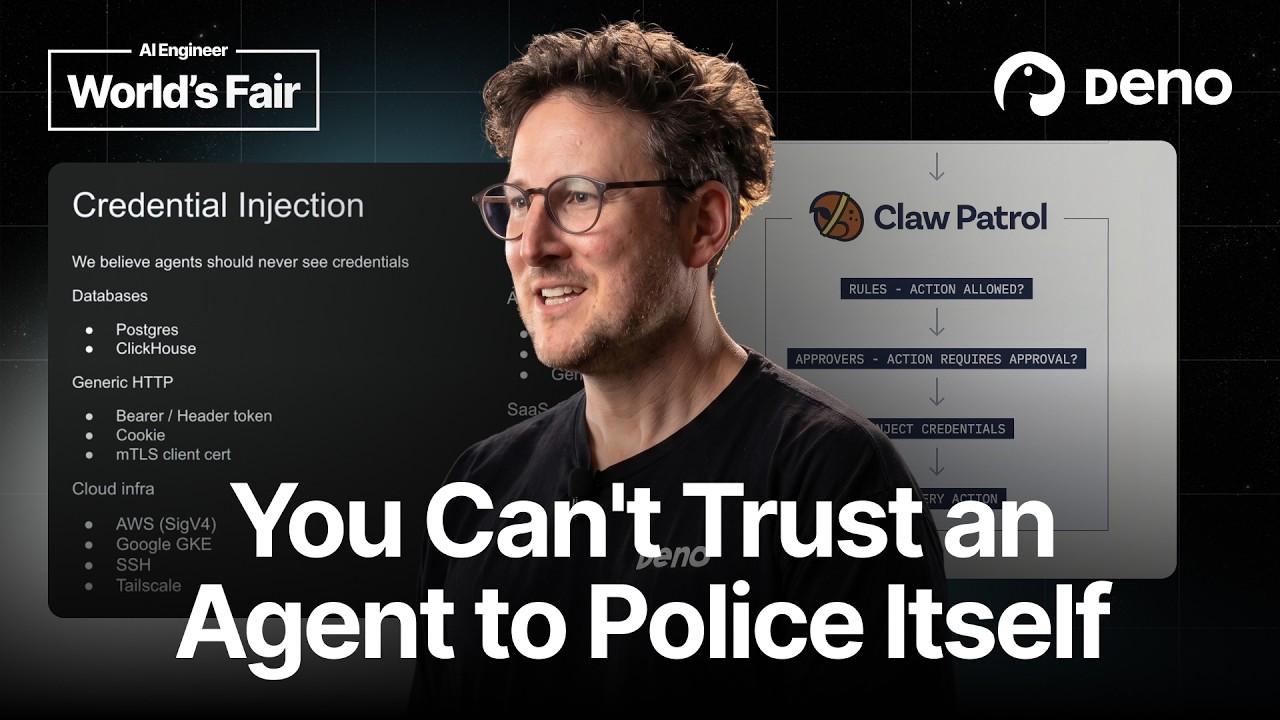
Deno treats its incident agents as untrusted and filters their traffic in a proxy
Ryan Dahl, CEO of Deno, gives incident-response agents read-write access to production and puts the guard outside them: a proxy that parses protocols such as Postgres, holds the credentials and applies rules kept in Git.
 Watch from 1:18
Recording by AI Engineer.
The idea
The speaker’s argument, in our words.Dahl treats the agents as untrusted software and does not put the guard inside them. Since each agent runs on its own VM, every action that matters leaves as bytes on the network, and that is where Deno checks it.
The usual controls each see only part of that traffic: LLM gateways see calls to the model provider, HTTP proxies see HTTP, and MCP permissions stop applying once the agent spawns psql directly. So Claw Patrol, Deno's open-source proxy, parses each protocol itself, and its rules can block an action or route it to an LLM judge or a person in Slack.
What they found
From the talk. Figures are self-reported unless stated.Deno gives its incident agents (mainly OpenClaw) read-write access to production systems, and says they solve quite a lot of incidents where previously a human SRE would have been in the loop.
Systems named: Postgres, Kubernetes, ClickHouse, AWS, GitHub and Slack, for incidents on Deno Deploy. Self-reported; no count of incidents, success rate or time period is given.
Case study
1:18Treat the agent as untrusted software and do not put the guard inside it, because agents connected to the support system can be prompt-injected.
Dahl says Opus refuses repeated attempts to make it delete a users table, but that alignment is not enough for security. Deno runs each agent on a standalone VM, so file system access is not the concern; network traffic is (4:23).
Technical recommendation
3:16Read-only credentials and narrowly scoped MCP tools are worth doing but leave gaps: access to one system can lead to another, and once the agent spawns psql as a subprocess, MCP permissions no longer apply.
His example is a production Postgres inside an AWS VPC reachable through an EKS endpoint, where the agent could tunnel through and drop a table.
Technical recommendation
6:06Claw Patrol's rules live in a file of about 1,000 lines of HCL checked into Git; in a recorded demo, Codex in YOLO mode tried to delete the users table through psql and the proxy rejected the Postgres request.
Deno describing its own MIT-licensed tool. The demo was pre-recorded, not live. Rules come with fixture tests that assert a given request stays blocked (17:18).
Vendor claim
11:32
Why it matters
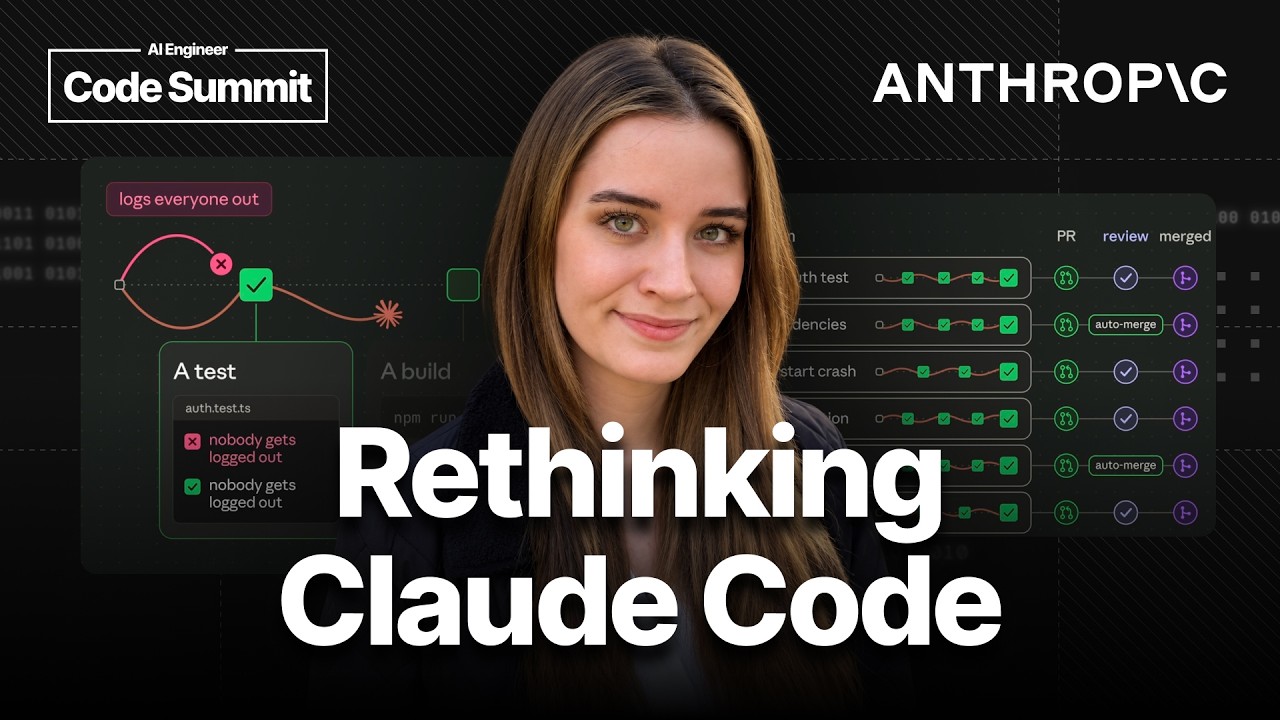
Our reading. Not said in the talk.Most agent guardrails watch tool calls or HTTP. Lydia Hallie (Anthropic) makes the same argument for Claude Code on a local machine: a deny rule sees the command, not what it opens, so the OS sandbox enforces the rule on child processes. Dahl's proxy does that for the network, and keeps the permission file under the same review and tests as code.
What one could try
- List every protocol your agents can reach production through (psql, kubectl, cloud APIs), and check which of your controls actually see that traffic.
- Keep agent permissions in a reviewed file in Git, with fixture tests asserting that destructive requests stay blocked.
- Inject credentials at a proxy so the agent process never holds secrets.
Limitations
- Deno presenting its own open-source tool; no figures on blocked actions, false blocks or incidents resolved.
- The design assumes each agent runs on its own VM; file system risks are handled elsewhere.
- The proxy holds every production credential, which Dahl acknowledges makes it a system to protect with great care.
Original sources
AI Engineer World's Fair 2026 · Aug 17, 2026
Security Firewall for Agents
Ryan Dahl · Deno · 19 min
This is our synthesis of the talk, checked against the transcript at the linked moments.