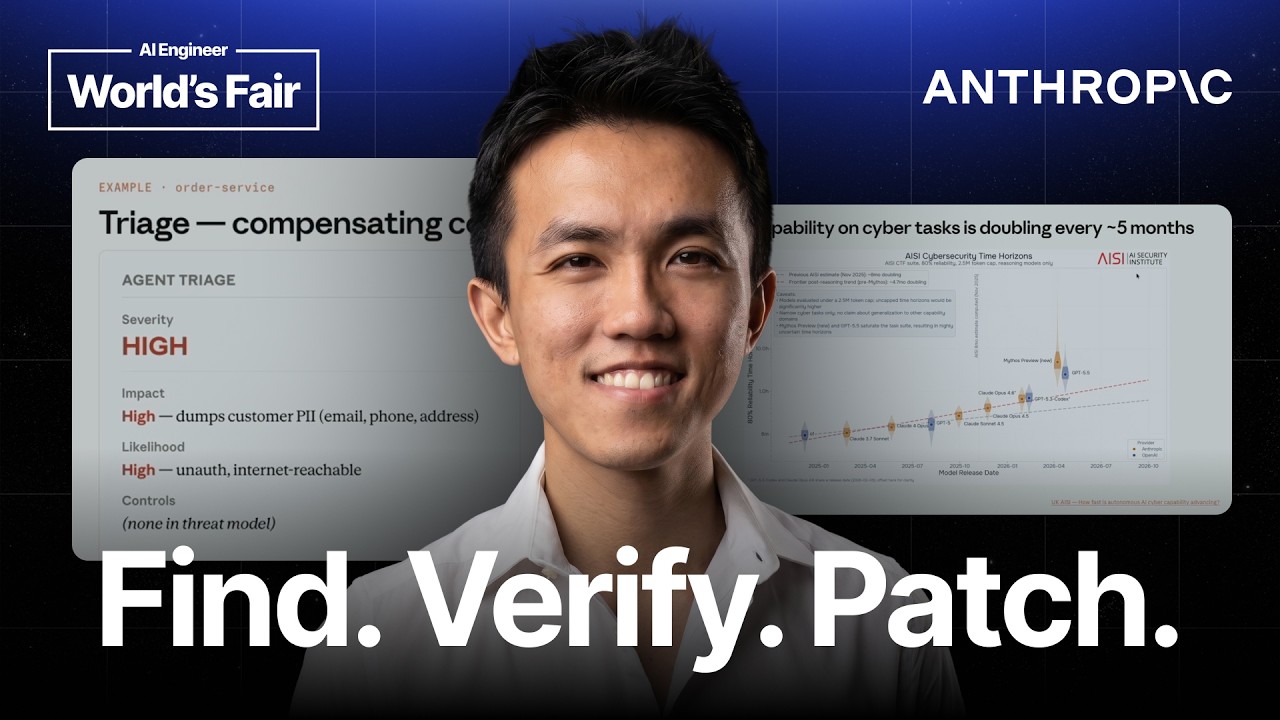
Anthropic's Eugene Yan has an independent agent try to disprove each vulnerability
Eugene Yan of Anthropic, drawing on work with security teams using Claude, splits vulnerability work into a discovery agent tuned for recall and a separate verifier tuned for precision that tries to disprove each finding.
 Watch from 4:24
Recording by AI Engineer.
The idea
The speaker’s argument, in our words.Yan treats a security harness like an ML pipeline. Discovery should find as many candidate vulnerabilities as possible; in his account, asking the same agent to also argue itself out of each one can make it self-censor and miss real bugs. Verification is a separate step with the opposite goal: an agent that sees only the reported vulnerability, not the discoverer's reasoning, assumes it is false and tries to confirm or refute it with a proof of concept. He stresses two prerequisites: a representative sandbox (a VM with no egress and no cloud credentials), and tools that let the model query the running system and read its logs as well as its source.
What they found
From the talk. Figures are self-reported unless stated.With a representative sandbox, the verifier builds and runs a proof of concept; in his example it gets only the suspect line, sends a request from a fresh container and sees customer PII come back.
Illustrated on a hypothetical order service with a SQL injection, not a real system.
Technical recommendation
12:39A penetration-testing team that gave the model tools to query the API, check responses and read logs and source reached almost 100% true positives, because the model could verify in the loop.
Reported by Anthropic about an unnamed team using Claude; no sample size, time frame or definition of the rate is given.
Vendor claim
10:41Validate patches on a ladder: the original proof of concept must stop working, the test suite must stay green, a fresh discovery agent attacks the patched code, and a human confirms before merge.
He says teams found that feeding this back to the patching agent improves patch quality greatly; no figures given.
Technical recommendation
15:45
Why it matters
Our reading. Not said in the talk.Ash Prabaker's team at Anthropic reached the same rule for app-building agents: their critic judges the output, not the builder's traces, because the builder's habit of convincing itself leaked into the critic. OpenAI's Codex Auto Review gives its reviewer the transcript, because its question is whether the user authorised an action, not whether a claim is true. In our reading, what a checker should see depends on the question it answers.
What one could try
- In a security or bug-finding harness, give the verifier only the finding and an instruction to disprove it, without the discovery transcript.
- Require an executed proof of concept in an isolated container (no egress, no credentials) before a finding is reported to engineers.
- Gate security patches on the original exploit failing, the test suite passing and a fresh agent failing to break the fix.
Limitations
- Anthropic describing practices built around its own models; it also sells Claude Security, mentioned at the end of the talk.
- The only figure (almost 100% true positives) has no sample or protocol; the recall benefit of separating discovery is asserted, not measured.
- Building a representative sandbox of a real system is, in his words, quite difficult.
Original sources
AI Engineer World's Fair 2026 · Jul 17, 2026
Using LLMs to Secure Source Code
Eugene Yan · Anthropic · 22 min
This is our synthesis of the talk, checked against the transcript at the linked moments.