Lydia Hallie uses reversibility to decide which agent actions need a hard rule
Lydia Hallie of Anthropic, speaking about Claude Code, offers a test for unattended coding agents: leave to the model what can be reverted, and enforce the rest with deny rules and an isolated environment.
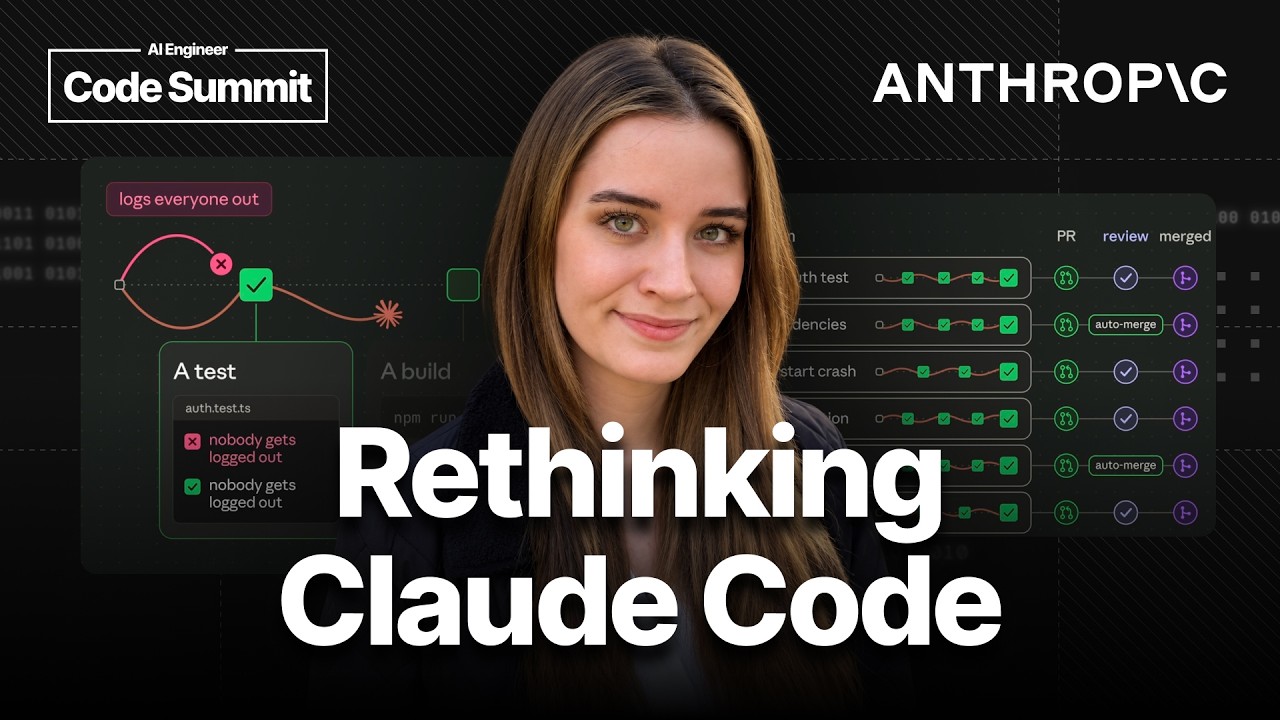 Watch from 5:46
Recording by AI Engineer.
The idea
The speaker’s argument, in our words.Hallie argues that once engineers stop approving each command, a classifier or the model's judgement lowers risk but guarantees nothing, so any guarantee has to live in the harness. Her test for what needs a hard rule is reversibility: if the agent gets this wrong once, can it be undone? Wrong code can be reverted and can be left to the model; discarding uncommitted work or reading a secret into the transcript cannot, so it needs a deny rule.
Rules have a gap of their own. A permission check sees the command, such as a test run, not the dependency code it executes, which could read secrets and send them elsewhere. For that she recommends a sandbox where the operating system limits files and network hosts for the command and its child processes, or a separate disposable machine where local secrets are not present. Pushed commits and messages still leave that machine, so the rules stay on there too.
What they found
From the talk. Figures are self-reported unless stated.Decide what needs a rule by asking whether a single mistake can be taken back: wrong code can be reverted, but discarding uncommitted changes or reading a key into the transcript cannot. Her example: the agent's default mode would allow reading .env, so add a deny rule.
Her heuristic, with the .env file as the worked example. In Claude Code, deny rules are checked before the classifier (6:13).
Technical recommendation
6:44A routine command like npm test runs dependency code the user did not write; permissions cannot limit what it reaches, so run commands in a sandbox where the OS restricts file reads, writes and network hosts, including for child processes.
Illustrated with a hypothetical compromised dependency sending .env or SSH keys to an unknown server. She notes that in her setup the shell sandbox does not cover hooks or MCP servers (8:49).
Technical recommendation
7:56Running the session on its own machine with a fresh copy of the repository keeps untracked secrets and SSH keys out of reach; deny rules stay on because pushes and connector messages still leave the machine.
Described with Anthropic's cloud sessions, which also limit network access by default.
Technical recommendation
9:51
Why it matters
Our reading. Not said in the talk.The reversibility question is useful outside Claude Code: it gives a team moving to unattended agents a way to decide which risks to leave to the model and which to enforce. Hallie's layering also shows what each control does not cover.
What one could try
- List the irreversible actions in your repo (reading secrets, force-pushing, deleting uncommitted work) and add explicit deny rules for each.
- Run agent shell commands in an OS-level sandbox with read restrictions on credentials, and check which agent components run outside it.
- For long unattended runs, use a fresh machine with restricted network access and only the secrets the task needs.
Limitations
- Anthropic describing its own product. The talk cites figures from an Anthropic study of its auto mode classifier; they are left out here because we could not find that study in Anthropic's own publications.
- Configuration details (rule precedence, sandbox coverage) are specific to the Claude Code version shown and may change.
- The exfiltration scenario is hypothetical, not an observed incident.
Original sources
AI Engineer CODE Summit 2026 · Nov 11, 2026
Rethinking Claude Code Best Practices
Lydia Hallie · Anthropic · 18 min
This is our synthesis of the talk, checked against the transcript at the linked moments.