Harvey's Joey Wang says the first piece to build is a loop that answers failing CI
Joey Wang works on Spectre, Harvey's internal cloud agent platform, whose agents have written about 10,000 PRs. His main advice is to own what happens after the code is written, starting with a loop that reads CI failures and pushes fixes.
 Watch from 1:33
Recording by AI Engineer.
The idea
The speaker’s argument, in our words.Harvey does not try to compete with coding agents such as Claude Code or Cursor. Spectre runs them in the cloud with what a laptop lacks: company secrets, a real copy of the stack, alerts and tickets, one set of rules and enough capacity. In Wang's own view, laptop agents top out at five to ten in parallel, and the hard part starts once a patch exists.
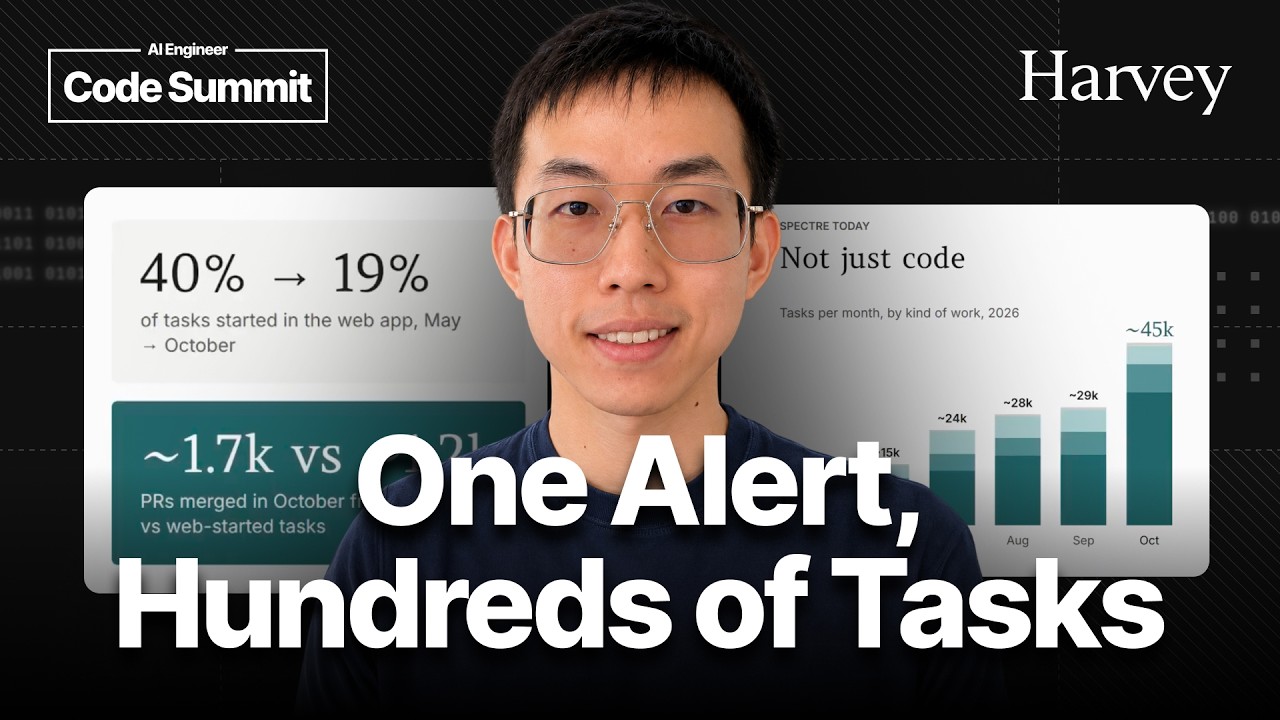
His example is an alert at 2 a.m. that an agent picks up, fixes, validates on a real copy of the stack and posts proof for. When CI fails, a follow-up loop reads the failure and pushes another fix while everyone sleeps. By morning the PR sits in the normal review queue under the same rules as any other, and the agent can auto-merge only once a person approves. After the loop was switched on for everyone in early October, four out of five agent PRs merged into the backend that month had been through it.
What they found
From the talk. Figures are self-reported unless stated.Laptop agents do not scale beyond about five to ten at once; past that you need a cloud with company secrets, the real stack, alerts, tickets, one set of rules and enough capacity.
Framed explicitly as his own view.
Speaker opinion
2:04An overnight alert is picked up by an agent that writes a fix, starts a real copy of the stack, posts proof on the PR, and lets the follow-up loop fix CI failures; the PR then waits in the normal review queue and auto-merges only after approval.
Described workflow.
Case study
3:40The follow-up loop was switched on for everyone in early October; that month four out of five agent PRs merged into the backend had been through it.
Self-reported. 'Been through it' means the loop was involved, not that it caused the merge. No comparison with merge rates before the loop.
Measured result
4:11Today only one merge in 20 carries proof that the change works.
Self-reported. Stated as an open problem he is working on next; how 'proof' is counted is not explained.
Measured result
11:30
Why it matters
Our reading. Not said in the talk.Producing a patch is the part coding agents already do well; CI failures and review routing are where the saved time can leak away. Wang's figure suggests that at Harvey the loop after the first patch touches most agent PRs that land, which is why he puts it first.
What one could try
- Subscribe agent tasks to their PR's CI results and start a bounded repair attempt on failure.
- Ask agents to attach evidence (test runs on a real environment) to the PR description.
- Keep auto-merge behind human approval for agent PRs.
Limitations
- Self-reported internal metrics from one company; no before and after comparison for the follow-up loop.
- The transcript has many recognition errors in this talk.
- Wang says only one merge in 20 carries proof that it works, so validation is still thin.
Original sources
AI Engineer CODE Summit 2026 · Nov 11, 2026
The harness has to finish the job
Joey Wang · Harvey · 13 min
This is our synthesis of the talk, checked against the transcript at the linked moments.