Where the cost of running AI agents shows up
Teams found the cost of agents in different places: tool definitions, history, latency, queues and people's attention. One team compared configurations side by side; none gives a cost in money that could be compared with another team's.


This collection asks where the cost of running agents shows up, not how much it is. The talks count different things. Philipp Schmid (Google DeepMind) and Towards AI count tokens per task and per turn. GitHub and Cloudflare count the tokens spent describing tools before any work starts. Anthropic counts time to first token. Uber and Harvey count queue throughput and load. AWS and Armin Ronacher (Earendil) count people's time and attention.
Most figures are self-reported and several speakers sell what they describe (GitHub, Cloudflare, Anthropic, Factory). Read them as each team's measure of where it hurt, not as numbers to add up.
The ideas
In Schmid's harness tests, cost per task varied far more than accuracy
Philipp Schmid (Google DeepMind) ran four coding-agent harnesses over about 350 tasks: scores were roughly equal, cost per task was not. In his demos, a bash-only harness saved tokens with a newer model that batched edits into one script, and nothing with an older one.
Tokens: harness choice moved cost per task more than accuracy in Schmid's tests. Factory adds one vendor example of batching tool calls into a script.
Google DeepMindMeasured resultRead the idea
Towards AI's tutor recalled more and cost less keeping full history than compacting
Towards AI tested context strategies for its AI tutor in small experiments. Keeping the full conversation beat summarising and clearing tool outputs on recall, latency and cost, because cached tokens were cheap. Compaction became necessary only on a local model with a 32K window.
Tokens: with caching, Towards AI's tutor was cheaper keeping everything than summarising. Small samples, one app.
Towards AIMeasured resultRead the idea
GitHub trimmed its MCP server's default tools after finding users kept the defaults
Sam Morrow, who leads GitHub's MCP server, says opt-in fixes for context bloat went mostly unused because people kept the default setup. GitHub instead cut the initial tool load by about half and then further, shortened tool outputs and hides tools a token cannot call.
Tool definitions: GitHub cut its server's default tools because almost nobody changed the defaults.
GitHubCase studyRead the idea
Cloudflare lets agents use its whole API by writing typed code in a sandbox
Matt Carey (Cloudflare) explains why one tool per endpoint could not cover Cloudflare's API, and how its Code Mode instead gives the model generated TypeScript types to write code against, run in an isolated worker with no secrets and controlled network access.
Tool definitions: Cloudflare swaps a tool list it estimates at over a million tokens for typed code, and runs a sandbox instead.
CloudflareVendor claimRead the idea
Anthropic split the agent loop from its sandbox so reasoning starts before setup ends
Anthropic's Managed Agents team first ran the agent loop and tool execution in one container. Isabella Kai He says separating them let the model start reasoning while the sandbox spins up and made each side replaceable on failure; Gagan Bhat adds that it keeps credentials away from the model.
Latency: Anthropic starts reasoning before the sandbox is ready. Vendor figures without a method.
AnthropicVendor claimRead the idea
Uber sped up its merge queue by gating peak traffic and letting weak overlaps go untested
Preetam Dwivedi and Manjari Akella (Uber) say PR growth they attribute to AI pushed p95 land time to 3 to 4 hours. Over months, peak-hour gating, deferrals and dropping weak conflict checks, backed by a verified/main pointer, took peak throughput to about 300 lands an hour.
Queues: Uber's cost was land time, and the gating it added pushed scheduling work onto some developers.
UberCase studyRead the idea
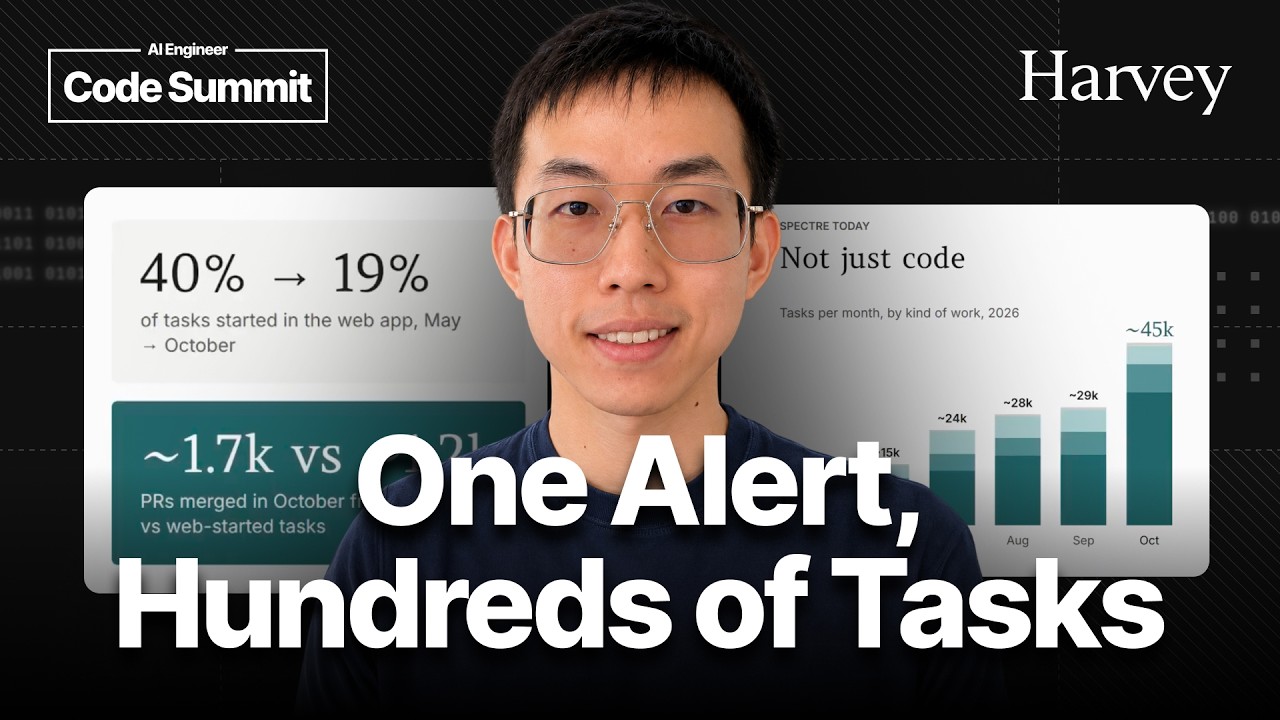
Once agents could start tasks, Harvey's platform needed dedup and a fair launch queue
Harvey made every action on its internal agent platform callable from a CLI. Joey Wang describes the two floods that followed, an alert storm and one engineer's bulk launch, and the dedup and fair launch queue built in response.
Load: once agents could start tasks, Harvey saw hundreds of duplicate investigations.
HarveyCase studyRead the idea
AWS's Kiro Crew team tracks how many agent sessions each developer can keep moving
Doug Clauson of AWS describes how the Kiro Crew team went from one to more than 50 agent sessions per developer. Each step came from removing a different reason the agents stopped to wait for a person.
People: AWS measures the developer as the bottleneck.
AWSCase studyRead the idea
Agents multiplied the projects Ronacher started but not the ones he keeps maintaining
Armin Ronacher of Earendil shows a year of his own data: agent working time grew to many times his workday and he started 141 repositories, while his prompts per day and the projects he actively maintains stayed roughly flat.
Attention: Ronacher started far more projects, not maintained more.
EarendilMeasured resultRead the idea


What we take from it
- Part of the token cost is paid before the agent does anything. GitHub and Cloudflare both found tool definitions filling the context and fixed it in different places: GitHub trimmed the server's defaults, Cloudflare replaced the tool list with typed code and took on running a sandbox. Neither reports task success before and after.
- Caching changes the arithmetic. Towards AI found that summarising history, a common cost-saving default, cost more and recalled less because it threw away cached tokens. With Schmid's result, it suggests measuring cost per completed task with caching on, not tokens sent. Both come from small samples.
- Latency is the cost fewest teams measure. Anthropic gives time-to-first-token gains without a method; Towards AI reports full history as faster per turn as well as cheaper.
- Where machine work gets cheaper, the cost moves to queues and people. Uber and Harvey added admission control, AWS counts sessions per developer, and Ronacher started more projects than he maintained. No talk measures what the waiting costs the people who wait.
- No talk gives a cost in money per task or per merged change that could be compared across teams. The one piece of arithmetic that travels is Towards AI's rule of thumb: compaction pays only if it shrinks the context by more than the cache discount. Anyone budgeting agents will have to measure their own.
The connections between these ideas are ours, not the speakers’. Each idea links to the talk moment that supports it.
Sources
- I deleted 90% of my harness (And It Got Better) 2 ideasNov 11, 2026
- Earning Autonomy: From Missions to Workstreams 2 ideasNov 11, 2026
- Context Engineering in 2026: Compaction, Memory & Cost 4 ideasAug 17, 2026
- Scaling GitHub for your Agents 1 ideaApr 27, 2026
- MCP = Mega Context Problem - Matt Carey 1 ideaApr 25, 2026
- Anthropic's Applied AI team on the Evolution of Agentic Surfaces 3 ideasAug 11, 2026
- Green Pull Requests Can Still Break the Trunk 2 ideasNov 12, 2026
- The harness has to finish the job 3 ideasNov 11, 2026
- Ship More as a Team of One with Kiro Crew 2 ideasNov 12, 2026
- The Software Atelier 3 ideasNov 12, 2026