Keyword vs. semantic search for AI agents: what does the evidence actually show?
Exa's CTO argues agents need semantic search; Hornet's CEO argues BM25 suits them well. Each sells what he argues for, and their evidence comes from different benchmarks, corpora and keyword setups. What each talk shows, and what a team should test. Our synthesis.
The cases
As each talk reports it.ExaJeffrey Pinner
- What they argue
- Agent queries carry constraints keyword ranking drops; semantic search plus wider data access does better
- Evidence in the talk
- Exa's own benchmark: about 9% without search, about 28% with keyword search; one example query
- Task and corpus
- Entity tables scored row by row; open web plus partner data
- What it doesn't control
- Keyword engine, models and task count not described; best setup changes several parts at once; Exa sells semantic search
HornetJo Kristian Bergum
- What they argue
- Long, knowledgeable agent queries make BM25 strong: exact matches, cheap, easy for the model to inspect
- Evidence in the talk
- No numbers of his own; cites BrowseComp+, a Hornet blog post and unnamed research on BM25 parameters
- Task and corpus
- Riddle-like questions with gold answers; about 100,000 web documents
- What it doesn't control
- Cited rather than shown; Hornet sells BM25 infrastructure
Towards AISamridhi Vaid
- What they argue
- Semantic search alone is not enough; the tutor uses hybrid search
- Evidence in the talk
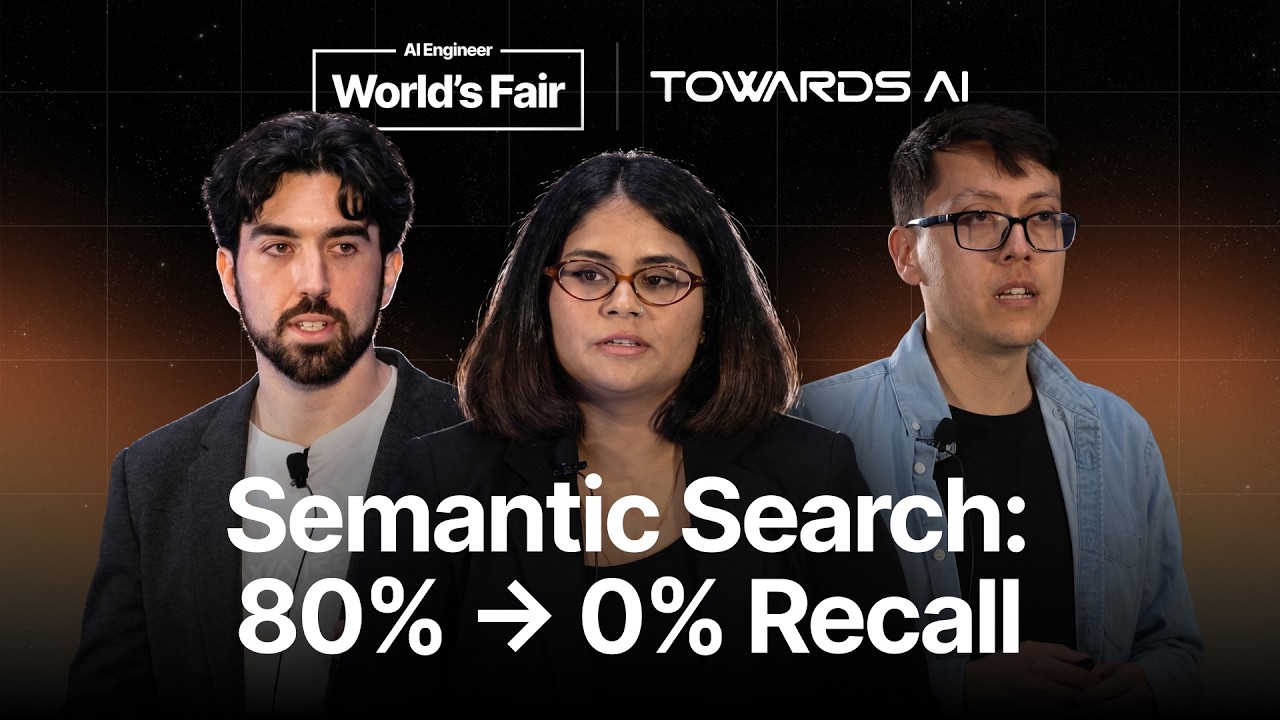
- Own tests: dense about 80% recall up to 200K tokens, 0% at 400K; BM25 100%
- Task and corpus
- Recall of buried facts in a tutor's documents, within local-model tests
- What it doesn't control
- Corpus, number of facts and embedding model not stated; one task and setup, not a general result for BM25
The comparison
Our synthesis across talks.Two talks start from the same observation and reach opposite conclusions. Jeffrey Pinner, CTO of Exa, which sells web search for agents built on embeddings, says agents write long, conditional queries: the mean query on Exa is about 12 words, against about three for people on Google, and the extra words carry versions, dates, places and exclusions that keyword ranking, in his words, "wasn't really designed to handle". Jo Kristian Bergum, CEO of Hornet, which builds BM25-based retrieval infrastructure for agents, says the same kind of user makes BM25 stronger: a model knows names, dates and product codes, writes long queries with search operators, reformulates when it misses, and can see why a literal match came back. BM25 is a decades-old scoring function that ranks documents by the query terms they contain.
Pinner's numbers come from Atlas, a benchmark Exa built. An agent must find entities that match a condition and fill in their attributes, and a row only counts if every attribute is right. Agents with no search scored about 9%; adding keyword search took them to about 28%, with most rows still incomplete or wrong. He then reports a higher score for Exa's full setup, which the transcript and the conference article give differently. That setup changes several things at once: a semantic index, proprietary data from partners, a knowledge graph and extraction of the passage that answers the query. The talk does not say which keyword engine was used or with what parameters, nor which models ran or how many tasks there were. His qualitative evidence is one real query that asked for companies outside the US and, under keyword retrieval, got a US company back.
Bergum shows no comparison numbers of his own in the talk. He cites three things. BrowseComp+, a public deep-research benchmark of riddle-like questions over about 100,000 web documents, where models answer accurately when the evidence is put in front of them, so finding it is the limit. Hornet's analysis of GPT-5's search trajectories on that benchmark, described in a company blog post, which found queries much longer than the human queries in old AOL search logs; the talk gives no figures. And recent research, not named, that he says shows the BrowseComp+ paper's BM25 baseline used parameters unsuited to long documents, with a "dramatic impact" on accuracy. In the original paper, he says, embedding models look much better than BM25; his point is that this depends on which BM25.
The measured comparison that sits closest to Bergum's case comes from a different talk by different people. The Towards AI team (Louis-François Bouchard, Omar Solano and Samridhi Vaid), who build an AI tutor, report that in their own tests dense retrieval recalled about 80% of facts with inputs of 50,000 to 200,000 tokens and 0% at 400,000 tokens for facts buried in the middle, while BM25 recalled 100% each time. The tests belong to the part of the talk about running models locally, and corpus, number of facts and embedding model are not given. That result comes from one task, recalling facts buried in long inputs, and one setup; it shows how the two methods behaved there, not that BM25 is better in general. The team's own conclusion was not BM25 alone: the tutor uses hybrid search, merging semantic and keyword results and re-ranking them.
These results cannot be lined up. The tasks differ: entity tables scored row by row, riddle questions checked against a gold answer, and recall of buried facts. So do the corpora: the open web plus partner data, a fixed set of about 100,000 web pages, and the documents in a tutor team's local tests. The keyword baselines differ too. Exa's is not described, and Bergum's argument is precisely that BM25 results depend on how it is tuned. Exa's best score bundles data access and extraction with semantic ranking, so even inside Atlas it does not isolate keyword against semantic retrieval. And the two main speakers sell the approach they defend: Exa wrote Atlas and sells semantic search; Hornet sells BM25 infrastructure. Exa's 28% says nothing about a tuned BM25, and Bergum's argument says nothing about how BM25 would do on Atlas.
They do agree on two things. Both place the limit in retrieval, not reasoning: Pinner with the 9% closed-book score, Bergum with models that answer well once given the evidence. And both say to score the finished task rather than one ranked list: Atlas only counts complete rows, and Bergum says ranking metrics such as nDCG on a single query matter less once an agent can reformulate. Their examples also involve different kinds of constraint, and here we add our own reading, which neither talk tested. Pinner's failure is an exclusion ("outside the US"), which ranking by matching terms does not express; Bergum's case rests on exact identifiers such as names, zip codes and SKUs, which he says embeddings represent poorly. Which method does better may depend on which kind of constraint dominates a team's queries.
What they found
From the talk. Figures are self-reported unless stated.On Atlas, where a row counts only if every attribute is correct, agents scored about 9% without search and about 28% with keyword search; Pinner reports a higher score for Exa's full setup.
Exa's own benchmark, used to make the case for Exa's search. Models, task count, dataset and the keyword engine and its parameters were not described. The full setup adds a semantic index, partner data, a knowledge graph and passage extraction, and its score differs between the transcript and the conference article, so it is not given here.
Vendor claimJeffrey Pinner · Exa
7:12The mean query on Exa is about 12 words and about 10% run to 17 words or more, against about three words for people on Google; in one real query asking for companies outside the US, keyword retrieval returned a US company.
Self-reported from Exa's own traffic. The human figure is given without a source. The US-company case is a single example on a slide.
Measured resultJeffrey Pinner · Exa
5:37The BM25 baseline in the BrowseComp+ paper, against which embedding models look much better, used parameters unsuited to long documents, and more recent research shows this has a large effect on accuracy.
Bergum cites research he does not name and gives no numbers in the talk. Hornet sells BM25-based retrieval infrastructure.
Speaker opinionJo Kristian Bergum · Hornet.dev
10:22In a different talk, the Towards AI team reports dense retrieval recalled about 80% of facts with 50,000 to 200,000-token inputs and 0% at 400,000 tokens for facts buried in the middle, while BM25 recalled 100% each time.
Towards AI's own tests for its AI tutor, in the part of the talk about local models; corpus, number of facts, runs and embedding model not stated. One task and one setup: it does not show that BM25 is better in general, and the team uses hybrid search in production. Not Bergum's evidence.
Measured resultLouis-François Bouchard, Omar Solano, Samridhi Vaid · Towards AI
58:31
Why it matters
Our reading. Not said in the talk.Teams choosing a search tool for an agent will hear both arguments, usually from vendors. Neither talk gives a result that transfers to another corpus or task. The steps below are our reading of what the three talks suggest testing, not results from any of them.
What one could try
- Log the queries your agent actually sends and sort them: exact identifiers (names, codes, versions) against conditions such as exclusions, dates or places.
- Run each candidate inside the same agent loop, with the same model, tools and query budget: BM25 with parameters checked against your document lengths, a dense index, and a hybrid of the two.
- Score whether the agent completes the task (every field right, the correct answer), not single-query ranking, and record tokens, latency and cost per task.
- When an answer is missing, check whether the document was in the index at all before blaming the ranking.
- Repeat the test at the corpus and document sizes you expect in production; Towards AI's dense results changed with input size.
Limitations
- An editorial comparison of three talks. No speaker responds to another, and every figure is self-reported.
- Atlas is a benchmark built by a company that sells semantic search, presented to make the case for its product. Its dataset, models and keyword configuration were not described.
- Bergum's benchmark claims are cited from a paper, a company blog post and unnamed research, with no numbers in the talk. Hornet's engine-performance chart uses anonymized engines and is not used here.
- The Towards AI figures come from a small experiment on a different task, recall of buried facts, with corpus, sample and embedding model not stated. BM25's 100% there does not show that it beats semantic search in general.
- Open questions: whether keyword, semantic or hybrid retrieval works better for agents in general; how a tuned BM25 would score on Atlas, or Exa's search on BrowseComp+; how much of Exa's gain comes from semantic ranking rather than partner data, the knowledge graph or passage extraction; whether the long-query observations hold outside each vendor's own traffic and analysis; whether the Towards AI drop at 400,000 tokens repeats with other embedding models.
Original sources
AI Engineer CODE Summit 2026 · Nov 12, 2026
What Your AI Doesn't Know
Jeffrey Pinner · Exa · 11 min

AI Engineer World's Fair 2026 · Sep 16, 2026
The unreasonable effectiveness of BM25 for agentic search
Jo Kristian Bergum · Hornet.dev · 18 min
AI Engineer World's Fair 2026 · Aug 17, 2026
Context Engineering in 2026: Compaction, Memory & Cost
Louis-François Bouchard, Omar Solano, Samridhi Vaid · Towards AI · 63 min
This is our synthesis of the talk, checked against the transcript at the linked moments.