Jo Kristian Bergum argues agents' knowledgeable queries make BM25 a strong search tool
Jo Kristian Bergum, CEO of Hornet, argues that BM25, an old keyword scoring function, works well in agent loops because models write long, precise queries, retry when they miss and can see why a term matched. He says its poor showing on one benchmark came from parameters unsuited to long documents.
 Watch from 2:58
Recording by AI Engineer.
The idea
The speaker’s argument, in our words.BM25 has not changed; its user has. Bergum's argument is that a model searching inside an agent loop knows names, dates, product codes and search operators, writes far longer queries than people do, and reformulates when results are poor. Exact matching suits that user, and because the match is on literal terms the model can see why a result came back and adjust the next query. It is also cheap compared with running large embedding models over a corpus.
He uses the BrowseComp+ benchmark to make two points. Given the right documents up front, models answer its questions with high accuracy, so the limit is finding the evidence. And the BM25 baseline in the original paper used parameters unsuited to long documents; later work he cites found that a tuned BM25 changes the picture, so 'which BM25' matters. He also argues that classic one-query ranking metrics no longer describe agent search, and that evaluation should check whether the agent completed the task.
What they found
From the talk. Figures are self-reported unless stated.Agents are a more capable search user: in Hornet's analysis of GPT-5 search trajectories on BrowseComp+, queries were much longer than human queries in AOL logs and used operators such as site and phrase search.
Hornet's own analysis, described in a blog post; no query-length figures given in the talk. Hornet sells BM25-based retrieval.
Speaker opinion
8:03The BM25 baseline in the BrowseComp+ paper used parameters that were inadequate for long documents, and more recent research shows this has a large effect on accuracy.
Cites unnamed recent research; no numbers given in the talk.
Speaker opinion
10:22Single-query ranking metrics such as nDCG matter less when an agent can reformulate and run many queries; evaluate whether the agent completes the task, for example answers correctly.
Recommendation with reasoning; no supporting data.
Technical recommendation
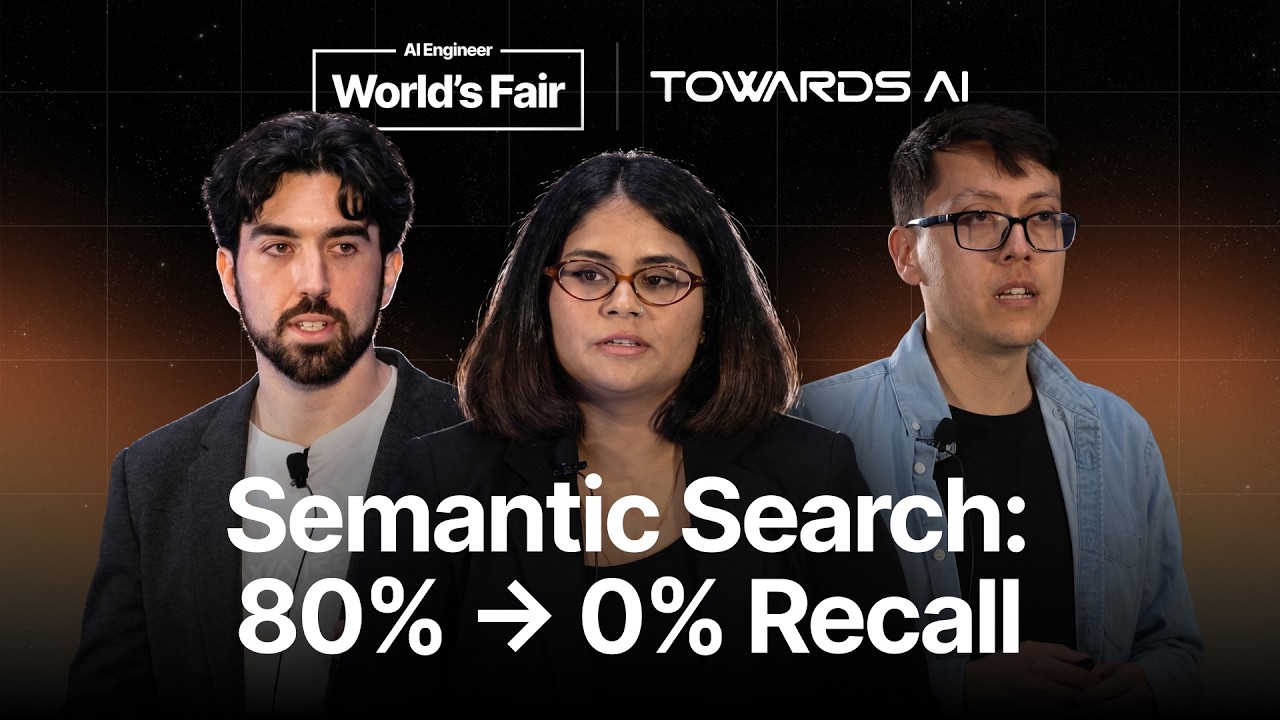
14:22In a different talk by different speakers, the Towards AI team reports that in their local-model experiments dense retrieval recalled about 80% of planted facts in 50K to 200K-token contexts but fell to 0% at 400K, while BM25 recalled 100% throughout.
Towards AI's own experiment for its AI tutor (Louis-François Bouchard, Omar Solano and Samridhi Vaid), run on a laptop setup; corpus, number of facts and runs not stated. The BM25 figure is at 59:09. They use hybrid search in production.
Measured result
58:31
Why it matters
Our reading. Not said in the talk.Exa's CTO, Jeffrey Pinner, starts from the same observation (agents write long queries full of constraints) and argues the opposite: that keyword ranking drops those constraints. Hornet sells BM25 retrieval and Exa sells semantic search, and the two talks rest on different benchmarks, corpora and keyword setups, so their claims cannot be read as competing results. Bergum's recommendation holds whichever retrieval a team picks: judge a search tool by whether the agent completes the task.
What one could try
- Before adopting embeddings for an agent's search tool, run a tuned BM25 baseline inside the same agent loop and compare task accuracy.
- Check BM25 parameters against your document lengths instead of using library defaults.
- Score agent search by end-to-end task success, not only by ranking metrics on single queries.
Limitations
- The speaker's company sells BM25 infrastructure; Hornet's performance comparison in the talk uses anonymized engines and is not used here.
- The benchmark claims are cited from papers and blog posts without numbers in the talk.
- The Towards AI result is a small experiment on a different task, recall of planted facts.
Original sources
AI Engineer World's Fair 2026 · Sep 16, 2026
The unreasonable effectiveness of BM25 for agentic search
Jo Kristian Bergum · Hornet.dev · 18 min
AI Engineer World's Fair 2026 · Aug 17, 2026
Context Engineering in 2026: Compaction, Memory & Cost
Louis-François Bouchard, Omar Solano, Samridhi Vaid · Towards AI · 63 min
This is our synthesis of the talk, checked against the transcript at the linked moments.