Zenity runs agent skills in a sandbox and records OS activity to see what they do
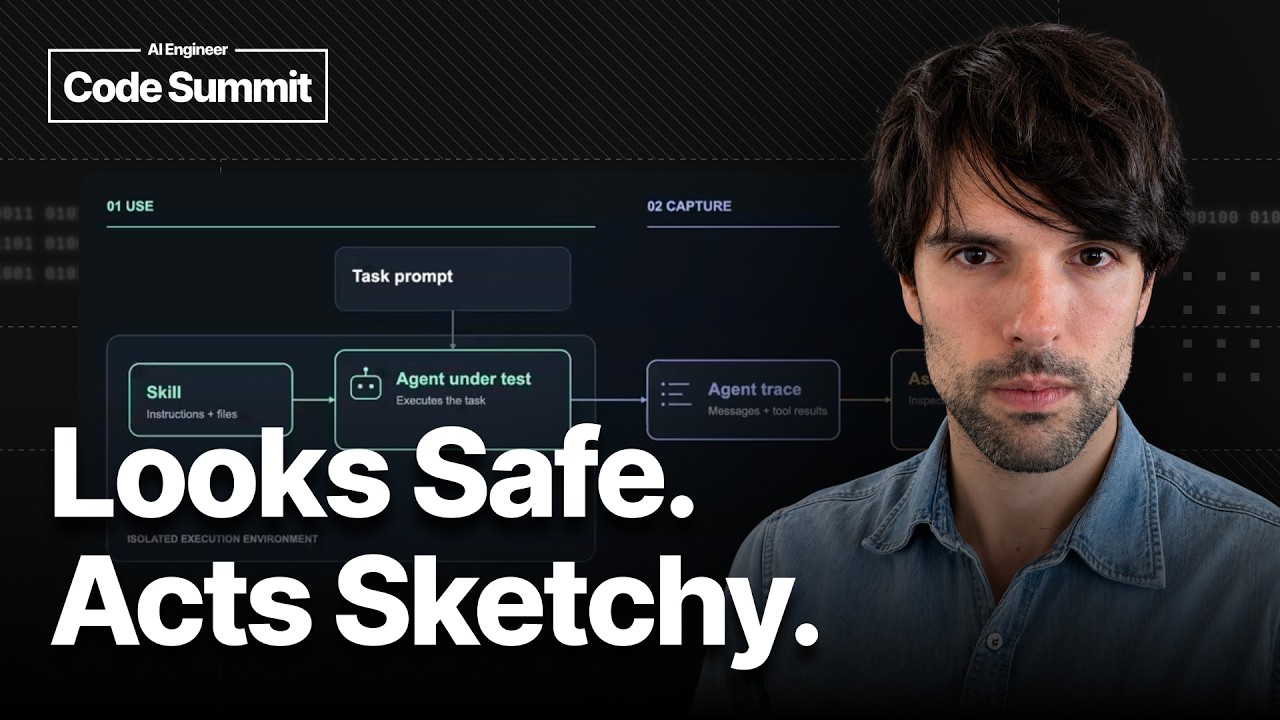
Roey Ben Chaim of Zenity describes a detonation chamber that runs agent skills in a sandbox and records processes, files and network traffic. He argues static and LLM-based scanning miss payloads that a skill loads later in the chain.
 Watch from 1:45
Recording by AI Engineer.
The idea
The speaker’s argument, in our words.Ben Chaim argues that an agent skill's SKILL.md is often only an entry point. It can fetch more instructions from another endpoint, install a package whose post-install script spawns other processes, or install a second skill. A scanner that reads the entry file misses all of that, and an LLM used as a scanner can be swayed by text inside the skill it is judging, as he says Trail of Bits research showed.
Zenity's answer borrows from malware analysis: run the skill with an agent in an isolated environment and observe what happens. He describes what it took to make that useful: a realistic environment per skill, a generator of tasks that exercise each route through the skill, an adversarial operator to get past model refusals inside the contained setup, and capture below the agent's own trace: process creation, file system events and network packets.
What they found
From the talk. Figures are self-reported unless stated.In many skills the payload lives elsewhere: a remote prompt, a package installed by a script, or code that downloads further packages, which a static read of SKILL.md misses.
Speaker's observation from Zenity's research.
Case study
1:45Agent traces miss side effects such as an npm post-install script spawning a process that reads files and contacts an endpoint, so the chamber also captures process creation, file system events and network packets.
Design rationale; no detection-rate comparison with and without OS telemetry is given.
Technical recommendation
6:17A proof-of-concept skill installed a second skill that fetched a SKILL.md from GitHub with hidden instructions to run a payload; one chamber run recovered the whole chain.
Proof of concept attributed to Zach Korman; the payload was not malicious.
Case study
7:08Zenity says the approach uncovered 100 malicious skills out of thousands, which were removed from skills.sh.
Reported by a security vendor about its own tooling; no exact denominator, false-positive rate or validation protocol given.
Vendor claim
7:57
Why it matters
Our reading. Not said in the talk.Teams are installing third-party skills into agents that hold cloud credentials and shell access. Reviewing the prose instructions does not cover what those skills pull in at run time.
What one could try
- Before approving a third-party skill, run it in a disposable container with process, file and network logging, using tasks that exercise each documented use.
- Flag skills that fetch instructions from remote URLs, install packages at setup, or register lifecycle hooks, and pin or vendor what they load.
- Run agents that use skills under least-privilege credentials so a harvester finds little to take.
Limitations
- Vendor describing its own tooling; detection rates are not measured against a labelled set and the '100 out of thousands' has no precise denominator.
- Behavioural testing only shows what ran in the tested environment, tasks and version; remote content can change later.
- The adversarial operator used to get past refusals is only described in general terms.
Original sources
AI Engineer CODE Summit 2026 · Nov 11, 2026
A Skill's Instructions Are Not Its Behavior
Roey Ben Chaim · Zenity · 14 min
This is our synthesis of the talk, checked against the transcript at the linked moments.