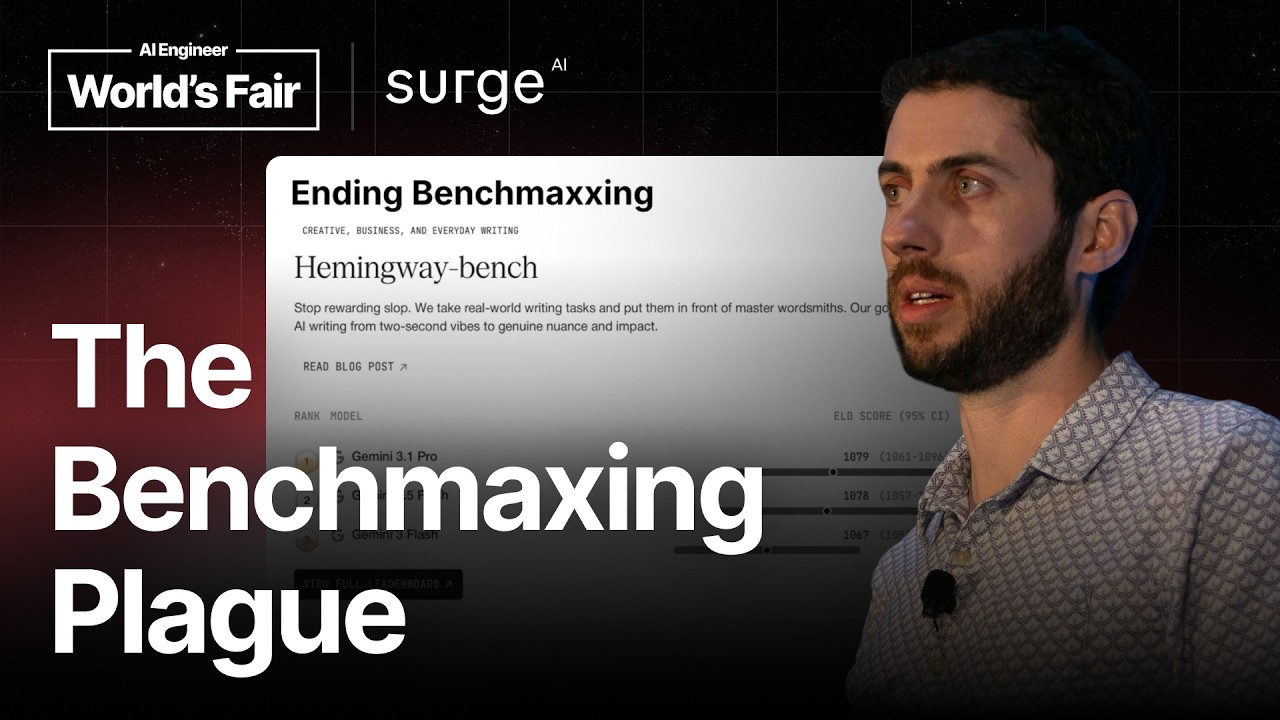
Surge's Nick Heiner says a verifier must check all a prompt asks, and nothing it doesn't
Nick Heiner (Surge AI) shows public benchmarks failing in both directions: an AutomationBench task rejects phone-number formats its prompt never specified, and an IFEval story prompt checks only a letter count, which a Cyrillic character beats. Surge sells human evaluation data.
 Watch from 3:09
Recording by AI Engineer.
The idea
The speaker’s argument, in our words.Heiner argues that many popular benchmarks fail for avoidable reasons: good tasks are expensive to build, so builders take shortcuts, and quality control gets skipped. One recurring defect is a mismatch between prompt and verifier. A verifier that enforces something the prompt never asked for punishes correct work, and one that ignores part of the request lets a model score without doing it. Either way the score fills with noise that does not separate strong models from weak ones.
He adds that a benchmark which stalls around 80% may simply have 20% broken tasks, and that during training nobody knows which tasks are broken until the rest are solved, so the broken ones keep handing out rewards and penalties that can distort model rankings. His list of remedies: experts design the tasks, inputs come from real work, tools actually work, the verifier and prompt match in both directions, everything is checked, and a private holdout set is kept.
What they found
From the talk. Figures are self-reported unless stated.In an AutomationBench task, the verifier hard-codes one phone-number format that the prompt does not state. Two models both score 20% on it: one through mistakes, the other because, Heiner says, it does the task right about 80% of the time but picks other formats.
One task chosen by the speaker. How the 80% was established is not described.
Case study
6:36An IFEval prompt asks for a story, but the verifier only checks that the ASCII letter I appears at most once, so a response using the Cyrillic І gets full credit; other IFEval prompts contradict themselves, such as repeating a response verbatim and translating it into Hindi.
Examples from the public IFEval set as shown by the speaker; no count of affected prompts.
Case study
8:46Verifiers must cover everything the prompt asks for, and everything the verifier enforces must be in the prompt; a gap on either side is unfair to models and adds noise.
Part of a list of practices he says good benchmarks need: expert-designed tasks, real input data, working tools, QC and a private holdout. The transcript states the first direction twice; the reverse direction (nothing enforced that the prompt does not ask) is what his phone-number example shows.
Technical recommendation
13:59In a separate talk, Ibragim Badertdinov (Nebius) shows the over-strict direction in SWE-rebench: a test taken from the original pull request required an exact substring in an error message, so a correct fix could still fail.
One example from Nebius's task screening; he says tests written after the fix tend to be overfitted to it. No count of affected tasks.
Case study
6:01
Why it matters
Our reading. Not said in the talk.Teams writing their own agent evals hit both failures: exact string matches on one side, assertions that miss half the request on the other. The over-strict side is not limited to public benchmarks. Nebius found it in tests taken from real pull requests, and Nik Pash (Cline) warns that verifiers written from a human fix tend to check details of that fix. Heiner's two-way check is a quick question to ask of each task before trusting its score.
What one could try
- For each eval task, list what the prompt asks for and what the verifier checks, and fix any item that appears on only one list.
- Read the failing runs of your strongest model; if many are correct answers in another format, the verifier is the problem.
- Keep a private holdout set that never appears in prompts, docs or training data.
Limitations
- Surge AI sells human evaluation data and builds its own benchmarks, so it has a commercial interest in this critique.
- Examples are selected by the speaker; there is no audit of how many tasks in each benchmark are affected.
Original sources
AI Engineer World's Fair 2026 · Aug 2, 2026
When Will The Benchmaxxing Plague End?
Nick Heiner · Surge AI · 17 min

AI Engineer Europe 2026 · Jun 4, 2026
SWE-rebench: Lessons from Evaluating Coding Agents on Real Software Engineering Tasks
Ibragim Badertdinov · Nebius · 16 min
This is our synthesis of the talk, checked against the transcript at the linked moments.